TL;DR
Google AI Overviews can reduce routine clicks but increase the value of being cited as a trusted source. Small businesses should publish clear answers, prove local and product expertise, add machine-readable context, and track citations alongside rankings.
Google AI Overviews for small business matter because search visibility now depends on being useful enough for both people and AI-generated answers. AI Overviews: Google Search's AI feature that creates summarized answers from search results. Small business: a corporation, partnership, or sole proprietorship with fewer employees or lower revenue than larger companies. For founders and local teams building visibility from zero, Earlyseo helps structure content so search engines and AI answer systems can understand it faster. The practical goal is not chasing every AI result; it is becoming a clear, trustworthy source that deserves inclusion.
Table of Contents
What are Google AI Overviews for small business?
Google AI Overviews are AI-generated summaries that appear in Google Search for selected queries, often above traditional organic results. For small businesses, they can answer informational searches before a click happens, but they can also cite helpful pages, product guides, local service pages, and expert explanations.
AI Overviews are part of a broader shift from link lists toward answer surfaces. Research on machine learning by Iqbal H. Sarker (2021) explains how algorithms learn patterns from data for real-world applications, which helps explain why clear, repeated, well-structured information matters in search systems: Machine Learning: Algorithms, Real-World Applications and Research Directions.
Key insight: small-business SEO in 2026 is not only about ranking a page; it is about making facts, services, prices, locations, and proof easy for AI systems to extract.
Core terms AI systems need to understand
| Term | Plain-English meaning | Small-business example |
|---|---|---|
| AI Overview | Google's generated summary of search results | A short answer for "best emergency plumber near me" |
| Citation | A source link shown inside or near an AI answer | A local HVAC guide cited by Google |
| Entity | A recognizable person, brand, place, product, or service | "Oak Street Dental", "Invisalign", "Austin" |
| E-E-A-T | Experience, expertise, authoritativeness, and trust signals | Staff bios, photos, reviews, policies, credentials |
| Structured content | Content arranged for easy extraction | FAQs, tables, definitions, schema, headings |
How do AI Overviews change small-business SEO?
AI Overviews change small-business SEO by rewarding pages that answer specific questions clearly, prove trust, and connect content to real entities such as locations, products, authors, and services. Traditional rankings still matter, but AI visibility adds another layer: being selected, summarized, and cited.
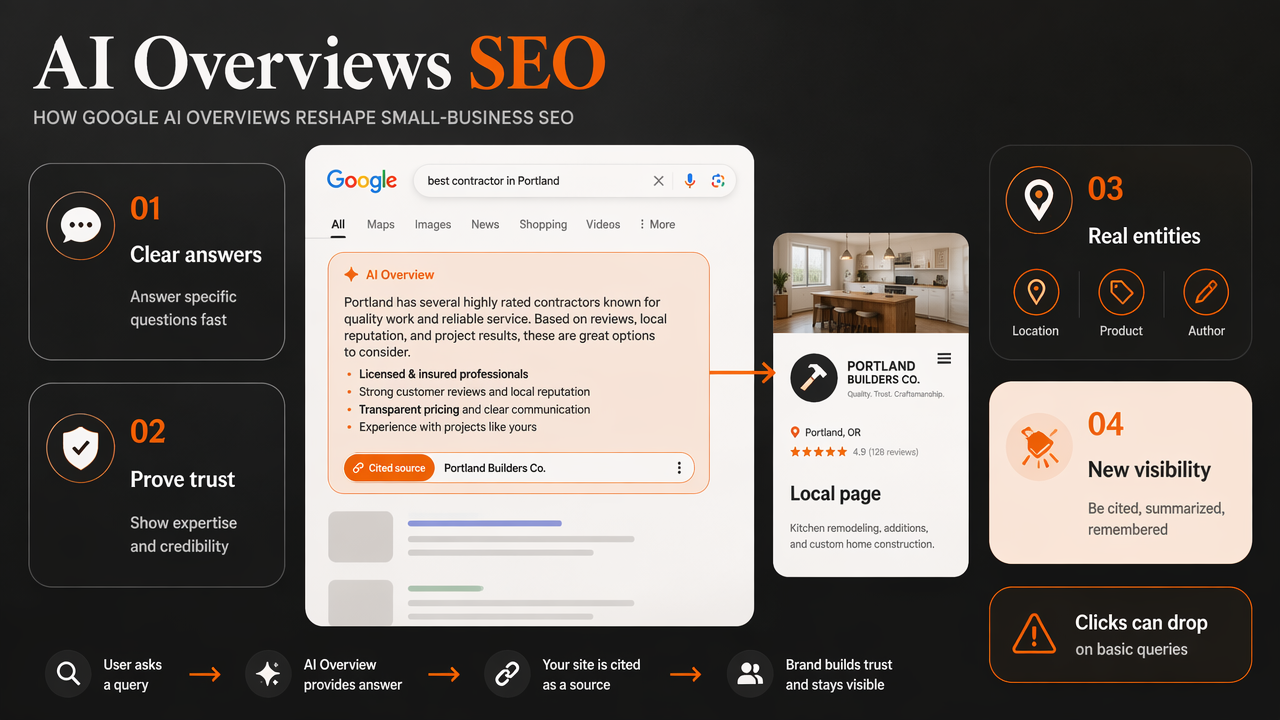
Some searches may satisfy the user inside the results page. That creates pressure on informational traffic, especially for basic "what is" or "how much does" queries. The opportunity is different: the cited source can become the brand that buyers remember before comparing vendors.
Deep learning research by Alzubaidi, Zhang, Humaidi, and others (2021) describes modern AI systems as dependent on data quality, architecture, and task context: Review of deep learning. In SEO terms, messy pages, vague claims, and thin service descriptions give models less reliable material to use.
Visibility signals that matter more in AI answers
- Direct answers: pages should answer the main query in the first few sentences.
- Named entities: include business name, service area, product names, certifications, and staff roles.
- Local proof: connect claims to real locations, reviews, case examples, photos, and policies.
- Freshness: update pricing, hours, availability, and process details for 2026.
- Readable structure: use short paragraphs, lists, comparison tables, FAQs, and descriptive headings.
- Machine-readable files: publish clear site guidance such as llms.txt guidance for AI crawlers when relevant.
The biggest misconception is that AI search makes websites optional. A weak site becomes easier to ignore, while a useful site becomes training material, citation material, and conversion material at the same time.
How can a small business optimize for AI Overviews?
A small business can optimize for AI Overviews by turning its site into a clean source of answers, proof, and context. The best framework is simple: define the query, answer it clearly, support it with evidence, connect it to a real business entity, and make the page easy to parse.
The Earlyseo platform fits this work because early-stage sites often need structured pages before they need complicated campaigns. Teams can pair publishing workflows with Earlyseo documentation to keep technical basics consistent while content quality improves.
A small site does not need thousands of pages to earn AI visibility. It needs a small set of pages that answer high-intent questions better than generic publishers.
A practical AI Overview optimization checklist
- Map questions to pages. Assign each buyer question to one page, such as pricing, comparison, service area, product fit, or troubleshooting.
- Write a 40 to 60 word answer first. Place the plain answer immediately under the heading.
- Add proof. Include credentials, real examples, policies, warranty details, locations served, and product specifications.
- Use structured formats. Add tables for comparisons, lists for steps, and FAQ blocks for related questions.
- Connect entities. Mention the business name, category, city, services, product brands, and staff expertise naturally.
- Keep pages current. Refresh dates, availability, local details, and screenshots when facts change.
- Improve crawl paths. Link service, blog, category, and location pages together using descriptive anchor text.
- Support publishing systems. Teams using CMS tools can review Earlyseo integrations for cleaner workflows.
Foundation model research such as Meta's LLaMA paper by Touvron and others (2023) shows how language models handle large-scale text patterns: LLaMA: Open and Efficient Foundation Language Models. Clear structure gives these systems fewer chances to misunderstand a business page.
Small-business examples by site type
| Business type | Page to build | AI-friendly angle | Proof to include |
|---|---|---|---|
| Local service | "Emergency AC repair in Tampa" | Explain response times, fees, and service area | License, hours, reviews, photos |
| Ecommerce store | "How to choose a ceramic dog bowl" | Compare sizes, materials, and safety | Specs, return policy, product photos |
| B2B startup | "CRM migration checklist for small teams" | Give steps and risk controls | Case examples, integrations, security notes |
| Medical or dental office | "Cost of teeth whitening in Phoenix" | Explain price ranges and appointment flow | Provider bios, policies, location details |
| Restaurant or venue | "Private dining for 20 people in Denver" | State capacity, menu options, booking process | Photos, menus, accessibility, reviews |
Good pages do not read like keyword dumps. They read like a staff member answered the question, then organized the answer for a search engine.
How should small businesses track AI Overview visibility in 2026?
Small businesses should track AI Overview visibility by recording which queries trigger summaries, whether the business is cited, which competitors appear, and whether branded search or assisted conversions rise after content updates. Standard rankings still matter, but they no longer tell the full visibility story.
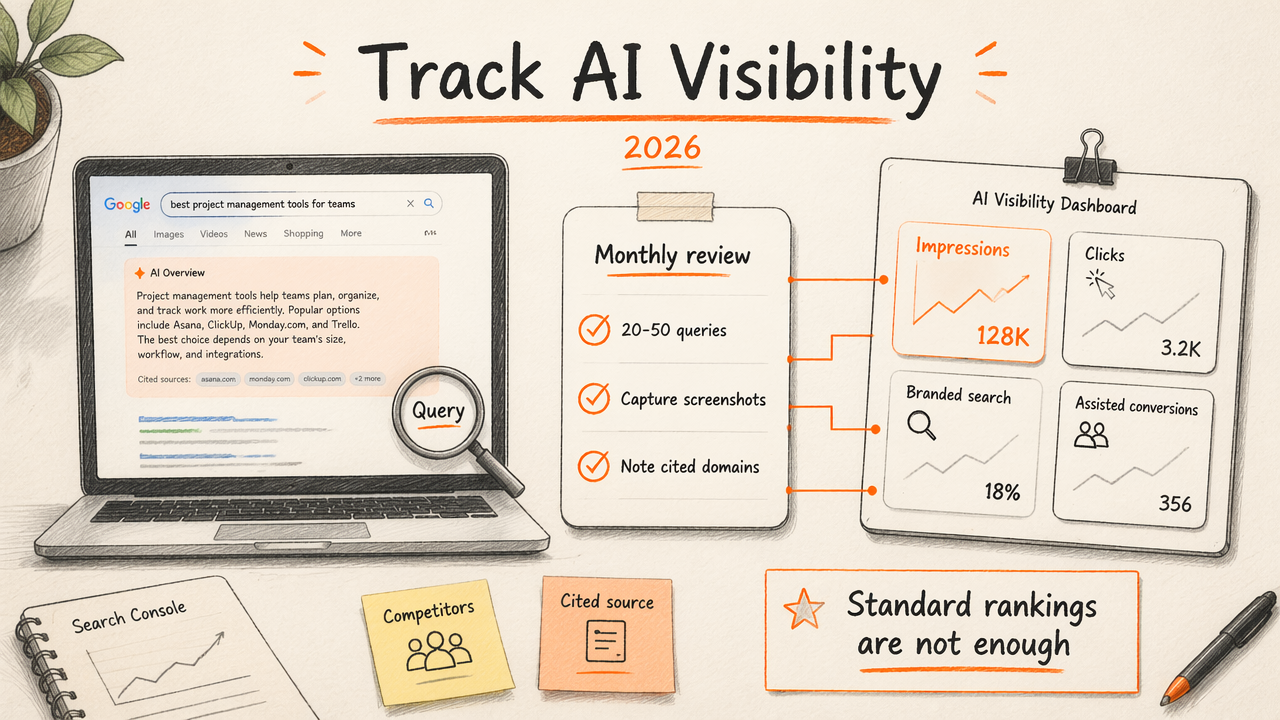
Tracking should stay practical. A small team can review 20 to 50 priority queries each month, capture screenshots, note cited domains, and compare those results with Search Console impressions, clicks, and branded query changes. The Earlyseo blog library can support ongoing learning as AI search behavior changes.
Search results can vary by location, device, account state, and query wording. That means a single screenshot should not be treated as absolute truth. Patterns over several weeks matter more than one result.
Monthly tracking fields to record
- Query searched
- Search intent, such as local, product, comparison, or informational
- Whether an AI Overview appeared
- Cited domains and cited page types
- Business citation status: cited, not cited, or indirectly mentioned
- Traditional organic rank range
- Google Business Profile visibility for local queries
- Page changes made that month
- Impressions, clicks, calls, form fills, or sales tied to the topic
A clean spreadsheet works at first. Larger teams can add rank tracking, log files, and conversion attribution later. earlyseo.com is a useful starting point for teams that want the process kept simple rather than buried under enterprise SEO tools.
The healthiest reporting view separates visibility, traffic, and revenue. AI Overviews may lower clicks on simple research queries while still improving brand memory for later searches. A local business should care most about leads, calls, bookings, and qualified visits.
FAQ: Google AI Overviews for small business
Google AI Overviews raise practical questions about eligibility, traffic, local SEO, and content quality. The safest answer is that no business can force inclusion, but any business can improve the odds by publishing clearer pages, stronger proof, and better technical signals.
Can a small business pay to appear in AI Overviews?
Organic AI Overview citations are not bought placements. Paid search can still appear in Google results, but AI citation eligibility depends on whether Google's systems consider a page useful for the query. Strong pages answer the question, match intent, include trust signals, and connect clearly to a real business.
Do AI Overviews replace local SEO?
AI Overviews do not replace local SEO because Google Business Profile, reviews, proximity, service pages, and local citations still influence discovery. Local businesses should treat AI answers as another visibility layer. Accurate hours, service areas, category pages, staff details, and review proof help both map results and AI-generated summaries.
What content is most likely to be cited?
Content most likely to be cited gives a direct answer, uses clear formatting, and includes specific proof. Examples include pricing explainers, comparison pages, buying guides, step-by-step service guides, and FAQs. Pages with vague claims, outdated details, or no visible expertise are less useful to answer systems.
How often should AI-focused pages be updated?
High-intent pages should be reviewed at least quarterly in 2026, especially if prices, services, locations, product inventory, or policies change. Evergreen explainers can last longer, but visible freshness helps when searchers need current information. Updates should improve accuracy, examples, internal links, and structured answers.
Conclusion
Google AI Overviews for small business are not a separate SEO channel; they are a new way Google packages answers from the open web. The strongest response is practical: publish clear answers, prove real-world expertise, structure pages for extraction, and track citations beside rankings.
A sensible next step is to choose ten high-intent customer questions, build or update one page for each, and review AI Overview visibility monthly. For teams that want a cleaner starting point, Earlyseo can help organize the technical and content foundation. Visit earlyseo.com, pick the first service or product page to improve, and turn it into the clearest source on that topic.