TL;DR
Small businesses should match SEO spend to the job: audits fix direction, local packages improve map visibility, content-led plans build search demand, and full-service retainers combine strategy with execution. A realistic package should show deliverables, timelines, reporting cadence, and ownership of assets before any contract is signed.
Small business SEO packages can save months of guesswork, but only when the package matches the business model, budget, and growth target. Wikipedia defines search engine optimization as the practice of improving website visibility and performance in search engine results pages, with the goal of increasing traffic quality and quantity. For teams that want structured execution instead of scattered tasks, Earlyseo gives small teams a practical way to organize SEO work, publishing, and visibility tracking.
Small business SEO package: a bundled set of SEO services, usually sold as a one-time project or monthly retainer, that may include technical fixes, keyword research, local SEO, content creation, link earning, analytics, and reporting.
A good SEO package is not a mystery box. It should name the work, the timeline, the owner, the expected output, and the reporting format before payment starts.
Table of Contents
What are small business SEO packages?
Small business SEO packages are bundled services that help a company improve search visibility without hiring a full in-house SEO team. Most packages combine some mix of technical SEO, on-page optimization, keyword research, content, local listings, analytics, and reporting, sold as either a one-time project or a recurring monthly plan.
A package works best when the scope is tied to a clear business outcome. A local dentist usually needs Google Business Profile work, location pages, reviews, and citations. An e-commerce store usually needs category optimization, product-page fixes, Shopify SEO, and content that supports commercial searches.
SERP research for this topic shows strong buyer interest around pricing, monthly retainers, affordable services, and what packages should include. Competitor pages also tend to cover the same basics, while often skipping sharper comparisons between audit-only, local, content-led, and full-service retainers.
Core package vocabulary
- Audit-only package: a short project that diagnoses technical, content, and search visibility issues.
- Local SEO package: a plan focused on maps, location pages, citations, reviews, and local intent keywords.
- Content-led package: a package built around keyword strategy, briefs, publishing, and on-page optimization.
- Full-service monthly package: a retainer that blends strategy, implementation, content, technical fixes, and reporting.
- Implementation support: the hands-on work required to publish changes, fix pages, and connect SEO tools.
The Earlyseo platform fits teams that want to connect SEO planning with publishing workflows instead of keeping strategy in spreadsheets. Teams using WordPress can pair package work with the Earlyseo WordPress integration to keep publishing closer to the SEO plan.
Which package tier fits each business goal?
The right SEO tier depends on whether the main problem is diagnosis, local visibility, content growth, or full execution. A business with no clear search plan should start with an audit. A storefront or service-area company should prioritize local SEO. A category-driven site should invest in content. A scaling company usually needs full-service support.
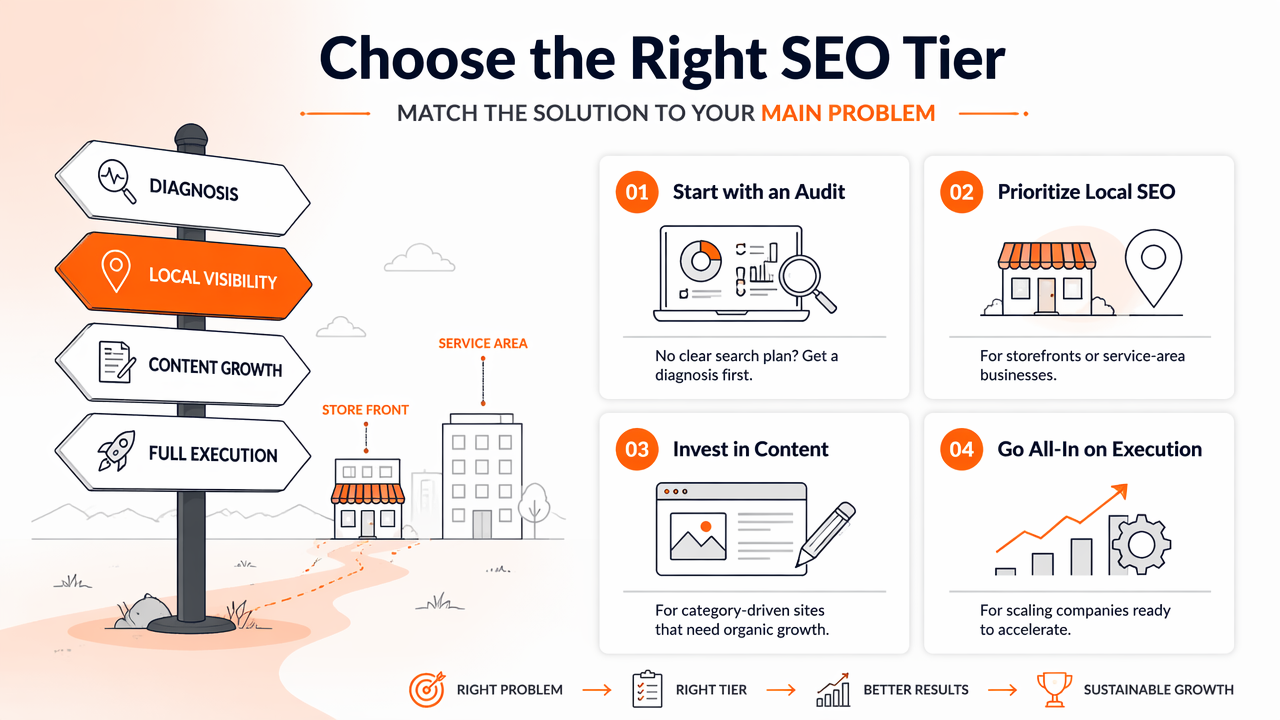
Competitor SERP data shows one 2026 article describing useful affordable packages as including keyword research, on-page SEO, local SEO, technical checks, and performance tracking. That list is a solid baseline, but the buyer still needs to know which mix matters most for the business model.
Package tier comparison
| Package type | Best fit | Typical deliverables | Realistic price range | Timeline |
|---|---|---|---|---|
| Audit-only | New site, traffic drop, messy setup | Crawl review, keyword gaps, technical findings, priority roadmap | $500 to $2,500 one-time | 1 to 3 weeks |
| Local SEO | Clinics, trades, restaurants, local services | Google Business Profile, citations, location pages, review plan, local tracking | $750 to $3,000 per month | 3 to 6 months |
| Content-led SEO | SaaS, e-commerce, professional services | Keyword map, briefs, on-page updates, blog or landing pages, reporting | $1,500 to $5,000 per month | 4 to 9 months |
| Full-service monthly | Growing company needing execution | Strategy, technical fixes, content, links, analytics, monthly reporting | $2,500 to $7,500 per month | 6 to 12 months |
One top-ranking competitor result in the research data states that small business SEO services often cost $2,500 to $7,500 per month, which aligns with the full-service retainer band above. Lower-cost plans can still work, but usually cover fewer deliverables or place more implementation work on the client side.
How to match goals to tiers
- Pick audit-only when rankings are flat, traffic has dropped, or a redesign is planned.
- Pick local SEO when calls, bookings, store visits, or map-pack visibility matter most.
- Pick content-led SEO when the site needs more non-branded search traffic and topical depth.
- Pick full-service SEO when internal teams lack time for technical fixes, publishing, and reporting.
- Pick e-commerce SEO support when product, collection, and category pages drive revenue.
Shopify merchants should check whether the provider can work inside the store setup. The Earlyseo Shopify integration is relevant when SEO tasks need to connect with e-commerce publishing instead of sitting outside the store workflow.
What should an SEO package include?
A credible SEO package should include strategy, technical checks, keyword targeting, on-page improvements, content planning, measurement, and clear reporting. The exact mix can change, but the package should never hide deliverables behind vague labels like "optimization," "authority," or "growth support" without naming the actual work.
Strong packages separate deliverables from outcomes. Deliverables are controllable tasks, such as fixing title tags, writing briefs, improving internal links, or building location pages. Outcomes, such as rankings and leads, are influenced by competition, site history, content quality, and market demand.
Minimum viable monthly scope
- Technical SEO: crawl errors, indexation checks, redirects, sitemap review, page speed flags, schema basics.
- Keyword research: search intent mapping, priority terms, local modifiers, product or service clusters.
- On-page SEO: titles, meta descriptions, headings, internal links, image alt text, and page copy improvements.
- Content: briefs, new pages, refreshed pages, blog posts, buying guides, or service pages.
- Local SEO: Google Business Profile updates, citations, reviews, service areas, and local landing pages.
- Reporting: rankings, organic sessions, conversions, work completed, next actions, and blockers.
The most useful report shows what changed, why it changed, and what happens next. A chart without decisions is not strategy.
AI visibility and 2026 deliverables
Search visibility in 2026 is broader than blue links. Google AI Overviews, AI Mode-style answers, ChatGPT, Perplexity, and other answer engines prefer clear entity signals, structured facts, and crawlable content. Package buyers should now expect work that improves both traditional SERP visibility and AI citation potential.
Modern deliverables may include definition blocks, comparison tables, FAQs, entity-rich headings, author pages, product data, and structured documentation. The Earlyseo documentation can help teams understand how structured SEO workflows connect with publishing and technical setup.
A practical AI-search add-on might include:
- Creating clean definitions for products, services, and locations.
- Adding comparison tables for buyer-intent topics.
- Publishing answer-ready FAQ sections.
- Improving internal links between commercial and educational pages.
- Making important site information easy for crawlers to access.
How should buyers evaluate price, timeline, and risk?
Buyers should judge an SEO proposal by scope, implementation ownership, reporting clarity, and time to expected traction, not by the lowest monthly price. Search results rarely change overnight, and a small retainer can be useful only when expectations match the amount of work included.
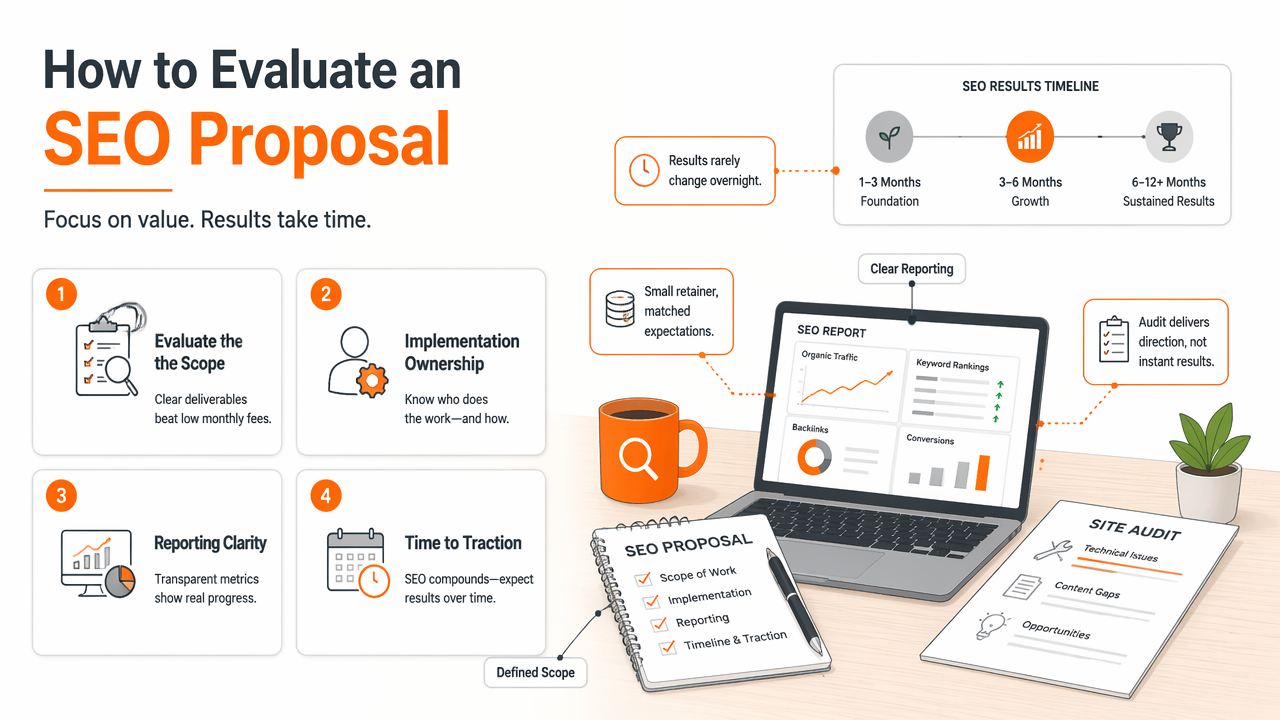
An audit can produce useful direction within weeks. Local SEO often needs several months because map visibility depends on profile quality, proximity, relevance, reviews, and local competition. Content-led SEO usually takes longer because pages need to be planned, published, indexed, and tested against competing results.
Proposal review checklist
A strong proposal should answer these questions before the contract starts:
- What pages, locations, products, or services are included?
- How many technical fixes are handled each month?
- How many content briefs, pages, or updates are delivered?
- Who publishes changes inside the CMS?
- What tools are included, and who owns the accounts?
- Which conversions are tracked?
- How often are reports reviewed?
- What happens after the first 90 days?
The SERP data for this keyword shows 123 total results, which suggests a crowded provider market. That makes proposal clarity important. Similar names can hide very different scopes, especially when one plan includes only recommendations and another includes hands-on implementation.
Common red flags
- Guaranteed number-one rankings for competitive terms.
- No access to analytics, Search Console, or conversion data.
- Reports that list rankings but not completed work.
- Link building with no quality controls or placement details.
- Content plans that ignore search intent.
- Packages that do not define revision rounds or publishing ownership.
A low price is not automatically bad. The real risk is a mismatch between promise and workload. A $500 monthly plan may be fine for monitoring and light edits, but not for technical cleanup, weekly content, local SEO, and link earning at the same time.
FAQs about SEO service packages
SEO package questions usually come down to cost, timing, deliverables, and control. Clear answers help small teams avoid overbuying, underbuying, or signing retainers that do not match the current stage of the business.
How much should a small business pay for SEO?
A small business might pay $500 to $2,500 for an audit, $750 to $3,000 per month for local SEO, or $2,500 to $7,500 per month for full-service support. The research data includes a top competitor result citing $2,500 to $7,500 per month as an average range for small business SEO services.
Are monthly SEO packages better than one-time audits?
Monthly packages are better when the site needs ongoing publishing, technical updates, local work, and reporting. One-time audits are better when the business needs diagnosis before committing to execution. Many companies start with an audit, then move into a smaller monthly plan once priorities are clear.
What is the fastest SEO package for local businesses?
Local SEO usually creates the fastest practical path because Google Business Profile updates, citation cleanup, review systems, and location-page improvements can be deployed quickly. Results still depend on competition, proximity, and existing authority, but local packages often show clearer early movement than broad national content campaigns.
Can SEO packages help with AI search visibility?
Yes, if the package includes structured content, entity clarity, answer-ready formatting, internal links, and crawlable documentation. AI systems tend to reuse concise definitions, tables, FAQs, and named comparisons. A traditional SEO package that only tracks rankings may miss this newer visibility layer.
Conclusion
The best small business SEO packages are clear, boring in the right ways, and tied to the business model. A buyer should be able to see the deliverables, price range, timeline, reporting cadence, and implementation owner before signing anything. Audit-only, local, content-led, and full-service plans all have a place, but they solve different problems.
For a practical next step, compare current needs against the tier table, then request proposals that show exact monthly outputs. Teams planning to publish consistently can review the Earlyseo blog resources and available Earlyseo integrations before building a workflow. More details are available on earlyseo.com for teams that want SEO planning connected to execution.