TL;DR
Google reviews support local visibility by improving trust signals, conversion confidence, and local prominence. The strongest review strategy in 2026 focuses on steady review volume, recent feedback, detailed customer language, and calm business responses that follow Google's rules.
A local business with weak reviews can lose the click before a buyer ever reaches its website. Google reviews for local SEO matter because ratings, review volume, freshness, and owner responses help people choose between nearby businesses in Google Search and Maps. For businesses building early organic visibility, Earlyseo helps connect review-led local search work with website SEO, content planning, and technical cleanup.
Table of Contents
What are Google reviews for local SEO?
Google reviews for local SEO are customer ratings and written feedback attached to a Google Business Profile that can influence local trust, click behavior, and perceived prominence in Google Search and Maps. They do not replace website SEO, but they strengthen the business entity that local searchers compare before calling, booking, visiting, or buying.
Local SEO: Local search engine optimization is the process of improving unpaid visibility for a business in location-based search results, similar to the definition of local search engine optimisation as visibility work for unpaid search results.
Key insight: Reviews act like public proof. Rankings may bring visibility, but reviews often decide whether that visibility turns into action.
Core review terms local teams should track
Review count: Total number of Google reviews on the Business Profile.
Average rating: The visible star score calculated from customer ratings.
Review recency: How recently customers posted feedback.
Review content: The words customers use to describe services, products, staff, location, price, wait time, and outcomes.
Owner response: The public reply from the business, including timing, tone, and helpfulness.
Google's own local ranking guidance says businesses should keep profile information complete and accurate, and it explains local ranking around relevance, distance, and prominence in its tips to improve local ranking on Google. Reviews connect most closely with prominence because they show real-world customer activity.
How do reviews influence trust, conversion, and local prominence?
Reviews influence local SEO by shaping three outcomes at once: whether Google has stronger evidence of business activity, whether searchers trust the listing, and whether that trust becomes a call, direction request, booking, or purchase. In practical terms, reviews sit between visibility and revenue.
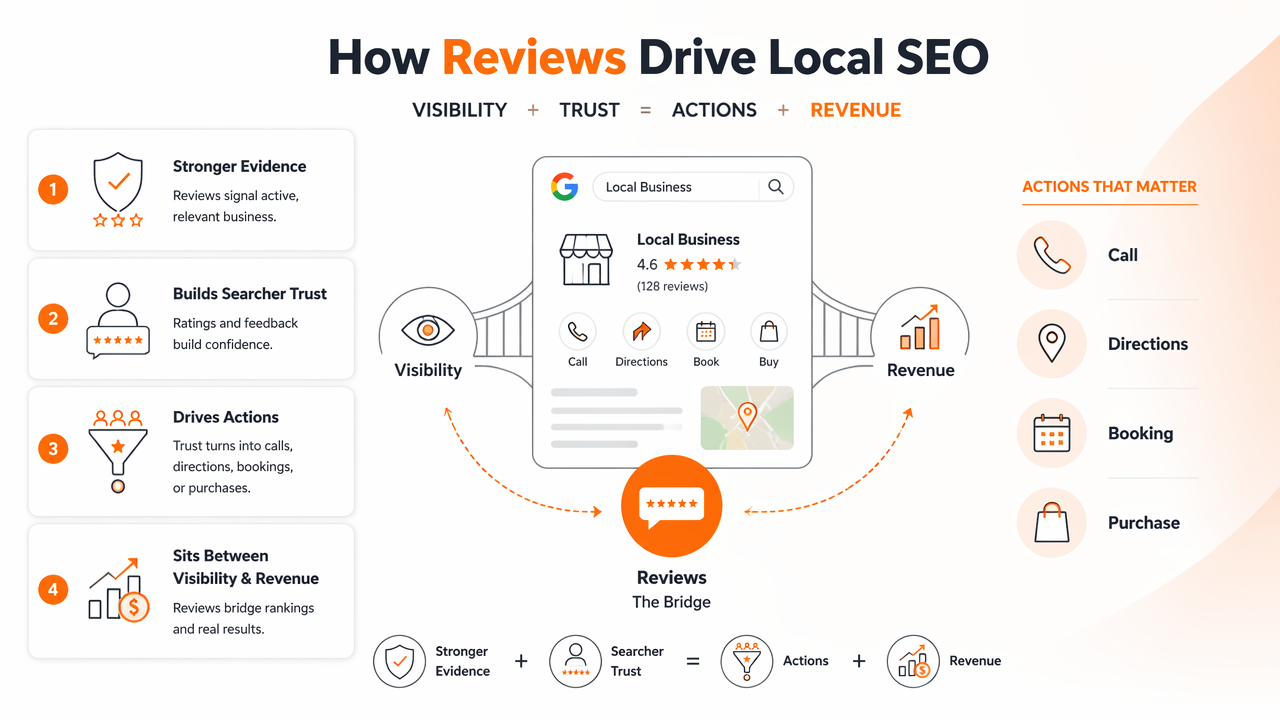
A high-ranking listing with thin or old reviews can feel risky. A lower listing with recent, detailed, positive feedback can win attention because the searcher sees proof from other customers.
Review signals and business outcomes
| Review signal | Local SEO role | Business impact |
|---|---|---|
| More reviews | Supports perceived prominence and activity | More proof during comparison |
| Higher rating | Improves first-glance confidence | Better click and call potential |
| Recent reviews | Shows the business is active now | Reduces doubt about current quality |
| Detailed wording | Adds service, product, and location context | Helps customers match needs |
| Owner replies | Shows accountability and service culture | Can soften negative feedback |
Trust builds fastest when review signals agree with the rest of the web presence. A bakery profile, for example, should have accurate hours, current photos, menu details, review mentions of custom cakes, and a website page about those cakes.
For teams still fixing the website side, the Earlyseo blog library can support the content layer that sits behind a stronger Google Business Profile.
Why review quality beats vanity metrics
A larger review count helps, but weak, vague, or suspicious-looking feedback does less for buyers. Reviews that mention the actual service, neighborhood, staff interaction, product type, appointment process, or outcome carry more practical value.
Useful review patterns include:
- Customers naming the service, such as "emergency plumbing" or "wedding alterations"
- Customers naming the location, branch, or nearby area naturally
- Customers describing the result, not just saying "great"
- Recent reviews appearing at a steady pace rather than in sudden bursts
- Business replies that sound human, specific, and calm
A strong review profile looks earned, current, and specific. A weak profile looks inactive, generic, or unmanaged.
Which Google review factors matter most in 2026?
The review factors that matter most in 2026 are quantity, quality, recency, keyword relevance, and response behavior. None works alone. A business with many stale reviews, no replies, and thin profile information can still lose ground to a competitor with fewer but fresher and more useful reviews.
Competitive SERP analysis for this topic found 129 search results and an average competitor article length of 3,311 words across four analyzed articles. Many competing guides emphasize review count, but the stronger strategy is a balanced review system that can be repeated every week.
Priority table for review optimization
| Factor | What good looks like | What to avoid |
|---|---|---|
| Quantity | Consistent growth over time | One-time campaigns, then silence |
| Quality | Specific customer stories | Thin praise with no detail |
| Recency | New reviews every month where possible | A profile that looks abandoned |
| Keywords | Natural service and location language | Prompting customers to stuff phrases |
| Responses | Helpful replies to positive and negative reviews | Copy-paste replies everywhere |
Review keywords deserve careful handling. Businesses should not script customer feedback. Better inputs create better organic language: clear service names, accurate categories, updated products, and staff asking for honest feedback after real work is complete.
For multi-location companies or ecommerce brands with local pickup, technical consistency also matters. The Earlyseo platform can sit alongside tools listed in Earlyseo integrations to keep website publishing and local search work moving in the same direction.
How should businesses ask for Google reviews safely?
Businesses should ask for Google reviews by requesting honest feedback from real customers, using the same process for happy and unhappy customers, and avoiding incentives, review gating, or fake accounts. Google's review policies prohibit misleading contributions, so the safest system is simple, consistent, and easy to audit.
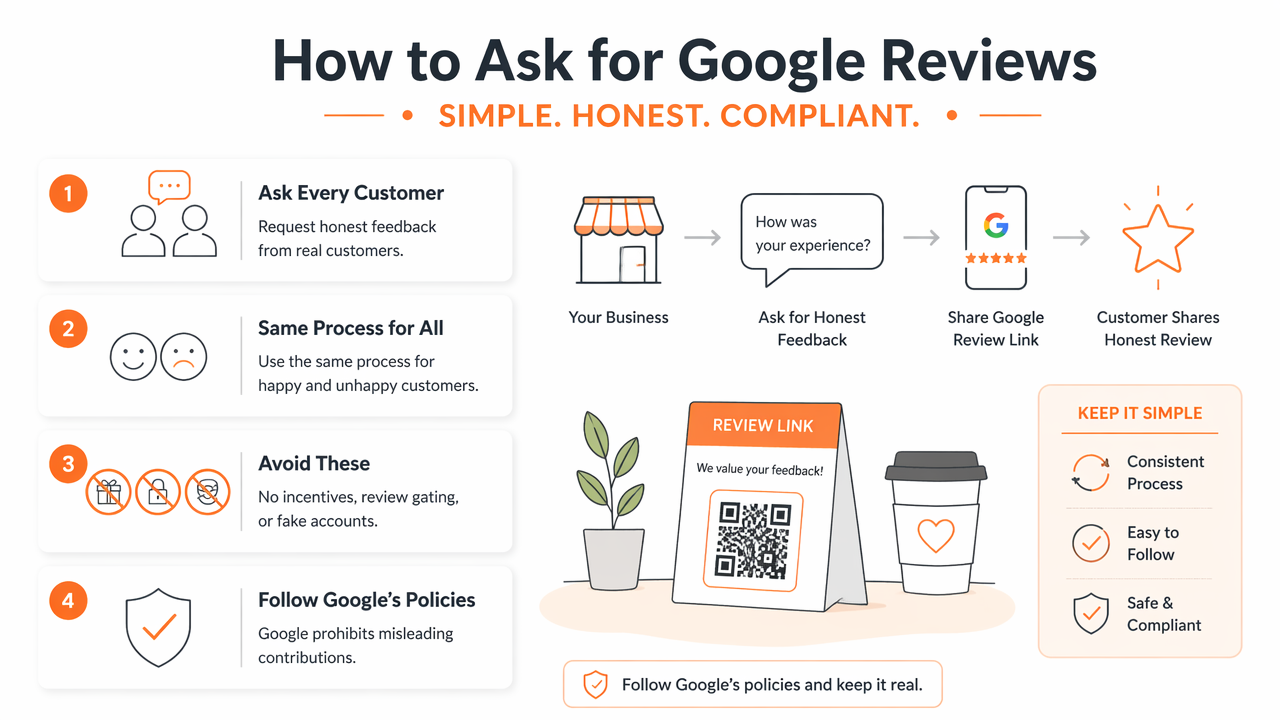
Compliant review request workflow
- Choose the right moment: Ask after a completed purchase, appointment, delivery, or support resolution.
- Use neutral wording: Request an honest review, not a five-star review.
- Send the direct review link: Reduce friction with the Google review link from Business Profile Manager.
- Ask everyone in the same stage: Avoid filtering only satisfied customers.
- Train staff on the script: Keep language consistent across phone, email, SMS, and checkout.
- Track requests, not pressure: Measure whether the ask happened, not whether the customer complied.
- Respond after posting: Thank customers and address issues professionally.
A safe request sounds like this in plain language: "Feedback helps the business improve and helps local customers compare options. A Google review is appreciated if there is time to share an honest experience."
Common mistakes that weaken review value
Risky review habits can damage trust and may violate platform rules. The most common problems come from trying to control sentiment rather than asking for honest feedback.
Avoid these practices:
- Offering discounts, gifts, or perks for reviews
- Asking only happy customers while blocking unhappy ones
- Posting employee, owner, family, or fake customer reviews
- Copying the same response on every review
- Arguing with customers in public replies
- Asking customers to use exact SEO keywords
Negative reviews are not automatically bad for local SEO. A thoughtful response can show accountability, clarify the situation, and help future customers judge the business more fairly. Silence often looks worse than imperfection.
How should review performance be measured?
Review performance should be measured by business outcomes, not stars alone. A useful dashboard connects review growth with calls, direction requests, bookings, website visits, local landing page traffic, and branded search demand. The goal is not a perfect profile; the goal is more qualified local action.
Review metrics that belong in a local SEO dashboard
| Metric | Why it matters | Review cadence |
|---|---|---|
| New reviews | Shows momentum | Weekly |
| Average rating | Shows public satisfaction | Monthly |
| Reviews by location | Finds branch-level gaps | Monthly |
| Response time | Shows service discipline | Weekly |
| Common themes | Reveals service and content ideas | Monthly |
| Calls and clicks | Connects reviews to action | Monthly |
Review text can also guide website content. If customers often mention "same-day repair," "parking," "vegan options," or "curbside pickup," those themes may deserve clearer placement on service pages, local landing pages, FAQs, and Google Business Profile updates.
The Earlyseo documentation is useful for teams building repeatable SEO workflows around content, technical fixes, and publishing systems. For stores that connect local intent with product discovery, Shopify SEO integrations can help keep product pages and organic search activity aligned. More details about Earlyseo are also available at earlyseo.com.
What to expect in 2027
Local search is moving toward richer entity understanding. Reviews will likely matter less as isolated star counts and more as part of a wider trust profile that includes photos, service details, products, website content, citations, and customer engagement.
AI-generated summaries in search results may also make review themes more visible. Businesses with specific, recent, authentic feedback will be easier for search systems accurately than businesses with thin or outdated comments.
The next advantage is not more aggressive review collection. The advantage is cleaner customer proof across Google Business Profile, the website, and every local search touchpoint.
FAQ
Do Google reviews directly improve local rankings?
Google review count and score are widely treated as local ranking factors because Google's local ranking guidance discusses review count and score within prominence. Reviews should be viewed as one signal among many, alongside relevance, distance, profile completeness, website quality, citations, and real customer engagement.
How many Google reviews does a local business need?
There is no universal review number that guarantees rankings. The useful benchmark is the local competitor set. A dental clinic, restaurant, plumber, or boutique should compare review count, rating, and recency against nearby businesses appearing in the map pack, then aim for steady monthly growth.
Should businesses respond to every Google review?
Responding to every review is usually a strong practice when replies are specific and professional. Positive reviews deserve short thanks, while negative reviews need calm, factual responses that offer a path to resolution. Repetitive templates can look lazy, so variation matters.
Can review keywords help local SEO?
Review keywords can help clarify what customers associate with a business, but they must appear naturally. A business should never tell customers exactly what to write. Better service descriptions, accurate categories, and clear post-purchase prompts usually lead to more useful customer language.
Conclusion
Google reviews for local SEO work best as an ongoing trust system, not a one-time ranking trick. The practical next steps are clear: complete the Google Business Profile, ask every real customer for honest feedback, respond with care, review themes monthly, and turn common customer language into better website content. For businesses ready to connect reviews with broader organic visibility, Earlyseo can help structure the SEO work behind that local proof. Visit earlyseo.com and start with the highest-impact profile and website fixes first.